|
 Land
predators that are dangerous to humans include; Polar
Bears, Grizzly Bears, Lions, Tigers, Leopards, Hyenas, Wolves
and Crocodiles. This list is not exhaustive as there are many
other wild animals that are best avoided. Land
predators that are dangerous to humans include; Polar
Bears, Grizzly Bears, Lions, Tigers, Leopards, Hyenas, Wolves
and Crocodiles. This list is not exhaustive as there are many
other wild animals that are best avoided.
Large
carnivores cannot be outrun so are better faced. Try shouting,
throwing rocks or waving sticks which may confuse the animal
and make it back away. Running away is just what the prey
would do and could precipitate an attack. Be very careful
when camping in big cat country. Don't sleep in a tent with
anything that may attract a large creature, bears will rip
open tents to get at the contents.
Lion attacks are a regular occurrence in African countries
such as Tanzania and Mozambique, where there is an ongoing
tension between lion and man over territory and livestock.
There are as many as 120 attacks a year in Tanzania alone,
and three-quarters of them are fatal. The attacks are not
the work of so-called “man-eaters” – lions
that have developed a taste for human flesh.
 Generally,
a lion will attack for the same reasons a bear will: to
get to food; to protect itself or its young; or because it
has been surprised. Like bears, lions for the most part want
to avoid humans, and for every attack there are uncounted
confrontations that end agreeably for both parties. Generally,
a lion will attack for the same reasons a bear will: to
get to food; to protect itself or its young; or because it
has been surprised. Like bears, lions for the most part want
to avoid humans, and for every attack there are uncounted
confrontations that end agreeably for both parties.
The
basic tips for lion safety are similar to those given
to people travelling in bear country: stay calm; assess the
situation (Is the lion/bear hungry? Scared? Defending its
territory or its young?); stand your ground – don’t
run away and never turn your back on the animal; make yourself
larger by waving your arms and spreading your legs; and, if
the lion or bear attacks, fight like hell.
There
is one major difference, however, in the abundance of
online advice about confronting bears and lions in the wild:
Avoid eye contact with a bear at all costs, but maintain it
with a lion.
One
major similarity: If the lion or bear has decided you
are food, there’s pretty much nothing you can do to survive
unless you are able to outrun or outfight your attacker, or
can get to safety up a tree or in the safari jeep you probably
never should have left in the first place.
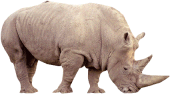 There
are many dangerous animals to be found roaming freely
in parts of Africa and Asia. As well as the big cats, these
include include rhinos, hippos, elephants and (African) buffaloes
which can be particularly aggressive. There
are many dangerous animals to be found roaming freely
in parts of Africa and Asia. As well as the big cats, these
include include rhinos, hippos, elephants and (African) buffaloes
which can be particularly aggressive.
Large primates like baboons and chimpanzees can be particularly
dangerous. It pays to be well informed when travelling into
areas where these animals are found. If you are going on a
safari to a game reserve, stay inside your vehicle when appropriate
and always follow the advice of your guide.
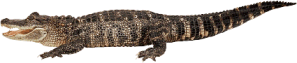 When
travelling close to rivers in Africa, South America and
parts of Australia beware of crocodiles which can be lurking
in shallow water near to the river bank. When
travelling close to rivers in Africa, South America and
parts of Australia beware of crocodiles which can be lurking
in shallow water near to the river bank.
Because we have so much contact with domestic animals,
we are much more likely to be injured by them than by wild
animals. Travellers have been injured by cats, dogs, cattle,
pigs, camels, water buffalo, elephants, etc. Be wary of any
domestic animals you do not know.
 By
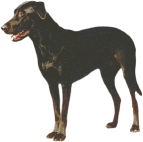
far the most common domestic animal responsible for attacks
on humans are dogs. Worldwide they are responsible for hundreds
of deaths annually. In many countries they often run wild
and may respond aggressively when approached. By
far the most common domestic animal responsible for attacks
on humans are dogs. Worldwide they are responsible for hundreds
of deaths annually. In many countries they often run wild
and may respond aggressively when approached.
If you are threatened by a dog pick up a stick and
wave it or some stones to throw at it or even pretend to if
none are around. Most dogs will retreat if they think you
are armed.
Dog bites not only inflict severe injury but can also
spread dangerous infections like tetanus or even rabies.
Rabies is present worldwide - except in the United
Kingdom, parts of Scandinavia, Japan, Oceania, Antarctica,
Australia, New Zealand, Malta and some of the Caribbean islands.
It can be transmitted to humans in several ways, but most
commonly via the bite of an infected domestic dog. Rabies,
if left untreated, will always cause death!
 Precautions Precautions
Do
not stroke dogs and cats and avoid contact with bats,
jackals, foxes and other wild animals. Animals that appear
unusually tame may be dying of rabies.
In
an area endemic for rabies all unprovoked bites or licks
should be considered a possible exposure.
In
the event of possible exposure to rabies immediate treatment
should be instigated:-
-
Thorough
cleansing of the wound should be undertaken with soap
or detergent and running water for 5 minutes.
-
Apply
an antiseptic such as iodine, chlorhexidine or alcohol.
-
Seek
medical assistance as soon as possible.
 It
may be necessary to commence rabies vaccination and anti-tetanus
measures. If you have been immunised against rabies prior
to being bitten you may still require further doses of vaccine.
Travellers who have never been immunised against rabies and
then receive a suspect bite, should be vaccinated within 24-48
hours. It
may be necessary to commence rabies vaccination and anti-tetanus
measures. If you have been immunised against rabies prior
to being bitten you may still require further doses of vaccine.
Travellers who have never been immunised against rabies and
then receive a suspect bite, should be vaccinated within 24-48
hours.
 Snakes Snakes
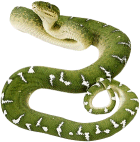
Most species of snakes are harmless and over half of the
venomous species do not have the capability or temperament
to be harmful. Even aggressive and venomous species will very
often inflict a "dry bite" which is venom free.
Snakes do not like to waste their venom on anything other
than prey species. Remember, only one in a thousand people
bitten by a snake actually dies as a result. Most deaths from
snake bites occur on the Indian subcontinent where they are
often forced into contact with humans.
However, if you are bitten by a snake you should always
be assessed by an expert as it is often quite difficult for
ordinary travellers to distinguish between dangerous and harmless
species.
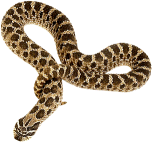 Dangerous
species of snakes are found in many tropical and desert
regions and local inhabitants are occasionally bitten and
sometimes killed by them. Foreign travellers are rarely
bitten. Dangerous
species of snakes are found in many tropical and desert
regions and local inhabitants are occasionally bitten and
sometimes killed by them. Foreign travellers are rarely
bitten.
Although snakes are found worldwide, the counties of the
world where travellers are most likely to encounter venomous
snakes are include; Australia, North, South and Central America,
Africa, The Indian Subcontinent and South East Asia.
Snakes
never attack without provocation, they are generally shy
and where possible, shun human contact. Avoid disturbing,
cornering or handling them.
Walking barefoot in vegetation, swimming in murky water
and climbing rocks and trees covered with foliage are all
risky. At night use a torch. Never tease a snake as teasing
could cause the snake to increase the dose of venom.
If you are bitten, move away from the snake to prevent
additional bites.
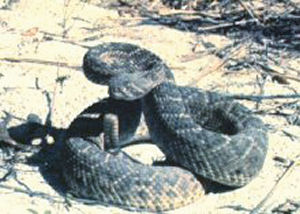 First
aid for snakebite is controversial. The only universally
approved first aid applicable globally, is immobilisation
of the bitten area/limb and keeping the victim still. The
victim should then be transferred to a hospital or clinic
for medical treatment if available. This should involve the
minimum of exertion by the victim as possible. First
aid for snakebite is controversial. The only universally
approved first aid applicable globally, is immobilisation
of the bitten area/limb and keeping the victim still. The
victim should then be transferred to a hospital or clinic
for medical treatment if available. This should involve the
minimum of exertion by the victim as possible.
Snake venom travels primarily via the lymphatic system.
Therefore, to prevent the spread of venom the movement of
lymph needs to be restricted. This is achieved by immobilising
the bitten area (usually a limb), keeping it level with or
just below the heart and by the application of a pressure
bandage.
You should NEVER apply a tourniquet to a snake bite. A
tourniquet is a tight band placed around a limb designed to
restrict the blood flow to and from the limb. Inappropriate
use of tourniquets can lead to unnecessary loss of the limb.
A splinted bandage to immobilise the limb can often be of
more use. A suction device may be used to help draw
the venom out of the wound without making cuts.
Whilst moving the victim to get medical help, monitor
their vital signs i.e. pulse and rate of breathing. If there
are signs of shock, lay them flat, raise their feet and try
to keep them warm. Reassure them that bites can be
effectively treated by trained medical staff.
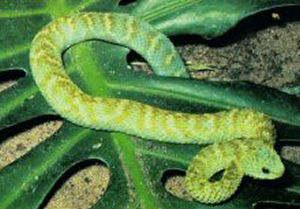 In
some areas where venomous snakes are endemic (such as
Australia), venom detection kits are often used by medical
personnel. These allow the site to be swabbed and a sample
of venom collected which is used to accurately identify the
snake or group of snakes to which the biter belongs to. This
enables the use of more specific and more effective antivenom.
Washing the bite may remove traces of venom that otherwise
could be detected by the kit. However, these kits are not
always available to medical staff in poorer developing countries
so in this instance cleaning the wound thoroughly with an
antiseptic soap or solution would a good idea. In
some areas where venomous snakes are endemic (such as
Australia), venom detection kits are often used by medical
personnel. These allow the site to be swabbed and a sample
of venom collected which is used to accurately identify the
snake or group of snakes to which the biter belongs to. This
enables the use of more specific and more effective antivenom.
Washing the bite may remove traces of venom that otherwise
could be detected by the kit. However, these kits are not
always available to medical staff in poorer developing countries
so in this instance cleaning the wound thoroughly with an
antiseptic soap or solution would a good idea.
Medical treatment will be greatly assisted if the snake
can be accurately identified. If the snake can be captured
and/or killed without risk of anyone else being bitten, take
it to show the doctor at the treatment clinic. Anti-venom
when available should only be administered by those experienced
in its use.
|
Avoiding
Snakes
|
-
When
you are travelling through areas where venomous
snakes are endemic and/or problems with them have
been previously reported:-
-
When
walking around, make plenty of noise, wear boots
or strong shoes and long trousers, and watch where
you step or place your hands.
-
Sleep
under a mosquito net that is well tucked in.
-
Never
sleep on the ground unless you are in a tent with
a sewn in groundsheet.
-
Avoid
areas where snakes may be hiding -- under rocks,
logs, etc.
-
Tap
ahead of you with a walking stick before entering
an area with an obscured view of your feet. Snakes
will attempt to avoid you if given adequate warning.
-
 After
dark, always carry a torch. After
dark, always carry a torch.
-
If
you see a snake, keep your distance.
-
Use
your common sense.
|
Spiders
& Scorpions
Although
most spiders are venomous, very few species are able to
penetrate human skin and inject venom. Of those that can,
only a few species in Australia and South America cause neurotoxicity
requiring specific anti venom treatment.
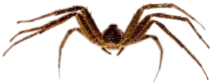 Harmful
species of spider include:- Harmful
species of spider include:-
-
The
Black Widow which is found in the Americas, Africa,
southern Europe and warm parts of Asia and Australia.
The bite gives rise to painful muscle spasms which can
last up to two days.
-
The
Brown Recluse or Fiddle Spider which is found in
the Americas, North Africa and the Mediterranean. Its
bite can be fatal but deaths are rare. The bite which
is initially painless causes localised tissue death leading
to severe scarring. Deaths are rare.
-
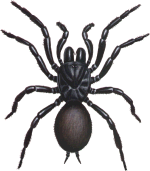
The
Funnel Web mainly found in south and eastern coastal
regions of Australia (the Sydney Funnel Web) and is a
particularly nasty spider which is easily capable of causing
human fatalities. Antivenin exists.
-
Huntsman
Spiders or Banana Spiders located in South America
are quite aggressive and cause painful bites but are rarely
fatal.
-
Wolf
Spiders are mainly found in South America but there
is a European species. The bites cause tissue death leading
to scarring up to 20cm long. It is rarely fatal.
 The vast majority of spider bites are non-fatal but some
can be very painful. Try to immobilise the affected limb and
seek medical assistance. Ice can be applied to the bite site
and antihistamines and pain killers may also be used to treat
any symptoms.
The vast majority of spider bites are non-fatal but some
can be very painful. Try to immobilise the affected limb and
seek medical assistance. Ice can be applied to the bite site
and antihistamines and pain killers may also be used to treat
any symptoms.
Bites from the truly poisonous spiders such as Funnel
Webs (left) should be treated like snake bites and medical
assistance should be sought as soon as possible. The spider
should be killed and taken along to the doctor for identification.
The spider bite victim should be transported as quickly and
as passively as possible to the nearest place where they can
be seen by a medically-trained person.
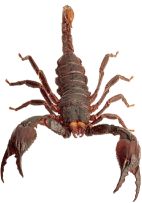 Scorpions
are usually found in arid regions. They like to hide in
dark shady places and sometimes they will hide inside your
boots. Therefore, you should always check your footwear
before putting them on in areas where scorpions are found. Scorpions
are usually found in arid regions. They like to hide in
dark shady places and sometimes they will hide inside your
boots. Therefore, you should always check your footwear
before putting them on in areas where scorpions are found.
They sting in self defense using their tail sting which
in most cases is very painful rather than life threatening.
However, potentially lethal scorpions do exist in Mexico,
South America, The Caribbean, North Africa, the Middle East
and the Indian subcontinent which can cause neurotoxicity
with blurred vision and breathing difficulty, myocardial damage
and pancreatitis. Immediate medical help should always be
sought if bitten.
First aid for scorpion bites is similar to that of
spider bites. Wash the sting area and apply a cold compress.
Immobilise the the victim and seek rapid medical help. Antihistamines
and painkillers may be used to treat the pain and swelling.
There are antivenins available for the more dangerous species
but these must be given quickly.
|
 Encounters
with animals
can cause problems for the traveller and any unnecessary contact
with them should be avoided. Many large mammals are easily
capable of killing humans.
Encounters
with animals
can cause problems for the traveller and any unnecessary contact
with them should be avoided. Many large mammals are easily
capable of killing humans.
 Stay
calm and get help.
Stay
calm and get help.


